

A Deep Dive Into Super Audio Frequency Induction Heaters: What Engineers and Hobbyists Care About
Nov. 19, 2025
1 What Frequency Range Defines “Super Audio” Induction Heating and Why That Range Is Used
Super audio frequency induction heating typically refers to induction systems that operate in the low-to-mid audio band — commonly in the range of 20 kHz to 50 kHz. This sits between “medium frequency” and traditional high frequency ranges, providing a sweet spot for many heating tasks. Manufacturers of SF-series induction machines often specify oscillation frequencies around this level for their IGBT-based systems.
This frequency range is selected because it balances skin effect, power penetration, efficiency, and component cost. At super audio frequencies, the induced currents concentrate near the surface, but not so strongly that they prevent good heating of moderately thick parts. That makes this range very practical for industrial heating, quenching, forging, and thermal treatment.
2 How Does Super Audio Frequency Affect Heating Performance and Depth
One of the biggest practical impacts of choosing super audio frequency is on heating depth and speed. Because of the skin effect, higher frequencies push current near the surface of a workpiece. But at 20–50 kHz, this effect is moderate enough to allow efficient heating into the material while still giving fast, localized heating.
In real-world use, this means that super audio induction heaters can heat both surface regions (where you might want quick response) and somewhat deeper zones for moderate-thickness components. Compared to very high frequency machines, the penetration is deeper; compared to low-frequency medium-frequency devices, the response is faster and more controllable. This balance makes super audio systems quite flexible for many industrial tasks.
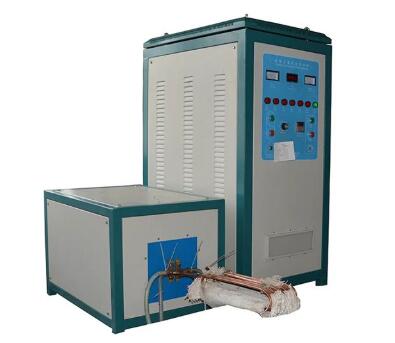
3 What Industrial or Workshop Applications Benefit Most from Super Audio Frequency Induction Heaters
Users often wonder what tasks are best suited for this frequency range. Super audio induction heaters are widely used in heating, quenching, forging, welding, annealing, and heat treatment of metal parts. For example:
Surface hardening of rotating shafts, gears, and small automotive parts — because you need enough penetration but also fast heating.
Annealing or brazing of metal components — where precision and localized heating are important.
Pre-heating or forging of bars or rods — for applications in fastener production, tool steels, or hardware.
Melting or preheating certain metals where a moderate coil depth is enough but without resorting to ultra-high-frequency designs.
Because super audio-frequency heaters often use IGBT modules and efficient design, they can operate in a 100% duty cycle, making them suitable for continuous industrial production lines.
4 What Are the Design Challenges and Critical Components for Super Audio Frequency Systems
Designing a reliable super audio induction heater is not trivial. Key challenges include:
Coil design: The shape, number of turns, and geometry of the induction coil strongly influence efficiency and heating uniformity. The coil must be matched to the workpiece and the power supply.
Power electronics: IGBT modules are commonly used. The inverter design must handle the chosen frequency and maintain a stable LC resonant circuit. Debugging oscillation and tuning the tank circuit is critical.
Featured content:
Leading Marine Propulsion Solutions Provider for Efficient ShippingCooling: Water cooling is often required to keep the IGBT driver, transformer (if used), and induction coil at safe temperatures. Without adequate cooling, continuous operation at high power will fail.
Control and timing: Many systems include adjustable “heat time,” “hold time,” and “cool time” parameters to more precisely control the heating profile. This improves repeatability and part quality.
Protection systems: Over-current, over-voltage, water flow, and overheating protections are essential. A good system must detect faults and shut down or alarm to prevent damage.
5 What Safety and Reliability Considerations Should Users Keep in Mind
Operating a super audio frequency induction heater safely is very important. Key considerations include:
Electrical risk: Even though the output voltage of many SF induction systems is relatively low, the currents involved are very high. Proper wiring, good ground, and secure connections are essential.
Cooling hygiene: If water cooling is used, impurities, flow rate, or air bubbles can impair cooling. Poor cooling can overheat the IGBTs or coil, leading to failure.
EM interference: Induction systems generate strong, rapidly changing magnetic fields. Without proper shielding or system layout, there is potential for electromagnetic interference with nearby electronics.
Component fatigue: Over time, the inverter components (IGBTs, capacitors) could degrade, especially if the system is constantly run at high power. Scheduled maintenance, checking component health, and replacing parts proactively are important.
Workpiece safety: The heated metal workpiece can become extremely hot very quickly. Operators must use appropriate protection, safe handling practices, and thermal sensors to prevent accidents.
Final Thoughts
Super audio frequency induction heaters combine a powerful mix of speed, control, efficiency, and penetration. By operating in the 20–50 kHz range, these systems offer a very practical compromise between deep heating and surface responsiveness — making them well suited for forging, quenching, hardening, annealing, and more.
However, realizing this potential requires careful attention to coil design, power electronics, cooling, and safety. Whether you are running a shop or designing a production line, understanding these five key questions and trade-offs will help you choose or build the right system.
255
0
0
All Comments (0)
Previous: Confronto tra scaricatore automatico di PCB SMT e altri modelli
Next: Leading Marine Propulsion Solutions Provider for Efficient Shipping
If you are interested in sending in a Guest Blogger Submission,welcome to write for us!

Comments